en

Private Client Newsletter – Family Foundations | 2/2025

New interpretations, rulings and practical guidance for family foundations

In the latest edition of our newsletter on family foundations, we have included analyses and practical conclusions from recent decisions by tax authorities and courts:

  • Sale of shares by a family foundation – discussion of the latest opinions of the Head of the National Revenue Administration and the conditions under which such a sale falls within the scope of permitted economic activity.
  • Foreign currency trading – limits on permitted operations and tax consequences following the ruling of the Provincial Administrative Court in Krakow.
  • Transfer pricing in family foundations – when is there a documentation obligation and how to avoid the risk of sanctions.
  • Each topic is presented on the basis of current interpretations, case law and market practice – with specific conclusions for foundation managers.

The newsletter is available at: https://newsletter.gww.pl/alert/Newsletter_Private_Client_2025-08-13.pdf


Depositing a work of art with a museum: tips for collectors

Works of art are considered – and not without reason – to be attractive investment assets.

The organisational and conservation challenges associated with private collecting of paintings, sculptures or applied art discourage many investors from purchasing them. The solution to these problems may be to transfer private collections to a prestigious museum (a so-called contractual museum deposit).

This institution is discussed on our Lexplorers blog by Aldona Leszczyńska Mikulska, attorney-at-law.

The entire article can be found at: https://tiny.pl/4fw7fmwc

Property abroad – what could go wrong?

One of the phenomena of recent years is the growing interest of Polish investors in purchasing foreign real estate.

This applies in particular to Mediterranean countries that are attractive to tourists: Italy and Spain. Many decades of limited wealth among Poles have meant that the market for investments in foreign real estate remains a young market. For this reason, some investors still fail to realise that behind the charming facades of Italian villas and Spanish residences there may be legal and tax surprises, resulting not only from the regulations in force in a given country, but also from the conditions of the local legal market.

In today’s article on Lexplorers, Aldona Leszczyńska Mikulska, attorney-at-law, takes a look at three markets popular among Polish investors: Italy, Spain and the United Kingdom.

Link to the article: https://tiny.pl/bpnp7v8z

The strategic role of WIT in the trade of wood-based products

In the trade of wood-based products, especially plywood, importers and manufacturers often face problems with the tariff classification of goods and the potential application of anti-dumping duties.

How should this issue be approached to ensure that commercial operations in this sector are not overly risky?

Rafał Wojciechowski writes about this today on Lexplorers, where he explains why binding tariff information is so important in this context.

Link to the article: https://tiny.pl/8rgzk8br

International award for Małgorzata Militz! ITR World Tax

We are delighted to announce that Małgorzata Militz, partner at GWW, has been included in this year’s ITR World Tax ranking, a prestigious guide to the best tax advisers in the world. More information about the award can be found here.

Małgosia is an expert specialising in VAT and is also the supervisor of the VAT litigation team.

For years, ITR World Tax has been selecting experts who shape tax practice in their jurisdictions.

Małgosia has received this distinction regularly for several years, confirming her position as one of the most highly regarded tax advisers in Poland.

We warmly congratulate Małgosia.

Major changes coming to CIT and PIT – draft amendment to the act

Latest proposals to amend the Corporate Income Tax Act and certain other acts

On Friday, 12 September, the Ministry of Finance published proposed amendments to the Personal Income Tax Act, the Corporate Income Tax Act and certain other acts. According to the Ministry, these changes are aimed at tightening up the tax system. Below we present the most important proposed changes in the area of PIT and CIT.

IP Box

If the amendment comes into force, a very important change will affect the IP Box relief, which is popular in the IT sector. According to the proposed changes, the preferential 5% rate on income from computer copyright will only be available if the taxpayer employs at least three persons who are not related to them. This condition is likely to exclude many freelancers and smaller entrepreneurs from benefiting from the IP Box relief.

Incentive programmes / financial instruments

The drafters want to extend the rules for assigning income from the realisation of securities or derivative financial instruments to the source from which the benefit arises. The planned changes are intended to extend this rule to income obtained from the realisation of financial instruments that are not currently covered by this rule (this applies, for example, to subscription warrants).
This may mean an increase in the tax burden associated with the implementation of incentive programmes by subjecting the income derived from them to taxation according to the tax scale (12% or 32%).

Sale of cars and other movable property received from immediate family

Current regulations allow for the sale of movable property without income tax if the transaction takes place after six months from the end of the month in which the purchase was made. In practice, this preference was often used in conjunction with tax exemptions for gifts made between family members (e.g. an entrepreneur bought a car from a lease and then gifted it to a close family member, who then resold it after six months without paying income tax).

The Ministry of Finance plans to introduce regulations limiting such practices. The sale of movable property (e.g. a car) will be taxed if:

  • the item was received by the immediate family of the entrepreneur who purchased it for private use after the end of the operating lease, and who had previously used it in business activities;
  • donations of property between family members are exempt from inheritance and gift tax;
  • the sale will take place within three years of receiving the donation.

Invoicing of related companies by partners taxed on a lump sum basis

The Ministry of Finance plans to introduce regulations excluding the possibility of applying preferential lump sum rates on recorded income in relation to income earned by taxpayers who are also partners in companies:

  • who, on account of services provided to these companies, earn income subject to a lump sum tax (e.g. 8.5%/12.5% – on account of rental),
  • and the cost of these services reduces the dividend from the company (taxed at 19% PIT).

The amendments provide for a flat rate of 17% to be applied to this type of income (instead of, for example, 8.5%/12.5%).

Housing relief

The amendment proposed by the Ministry of Finance clarifies the concept of ‘own housing purposes’ for the purposes of exempting income from the sale of real estate from PIT (Article 21(1)(131) of the PIT Act). According to the Ministry of Finance’s assumptions, the realisation of a ‘personal housing purpose’ will be the purchase of real estate (either residential rights or land for the construction of one’s own house) if the taxpayer does not own any other real estate or residential premises.

Basis for determining the solidarity levy

The Ministry intends to clarify the concept of ‘taxable income’ used for the purposes of the solidarity levy. It is proposed to clearly indicate that taxpayers may reduce the income used as the basis for calculating the solidarity levy by losses from previous years (losses from the same source of income from which the income used as the basis for calculating the solidarity levy will originate). The new regulations would also explicitly exclude the possibility of reducing income by other deductions or reductions available to natural persons when paying income tax.

Income from IP Box is also to be included in the basis for calculating the solidarity levy.

Estonian CIT – definition of hidden profits and expenses not related to business activity

The Ministry of Finance plans to expand the list of hidden profits to include, among other things, all types of fees and receivables arising from a lease, tenancy or other similar agreement. The change will make it necessary to tax the rent (lease) paid to a partner with Estonian CIT.

The government also plans to introduce a definition of expenses not related to business activities, according to which such expenses are considered to be expenses incurred for purposes other than generating revenue or maintaining or securing a source of revenue, as well as all types of public law fees and charges of a punitive nature. The change is intended to eliminate interpretative doubts as to the scope of Estonian CIT taxation of non-business-related expenses.

Estonian CIT – presumption of profit origin

According to the Ministry of Finance, due to the identified difficulties with the enforcement of the lump sum tax on corporate income in the case of distributed net profit, the government is proposing changes to the distribution of net profit in the lump sum tax on corporate income. The change introduces a presumption that any payment or distribution of profit in any form, after the end of taxation with a lump sum on company income, will be made from the profit generated during the period of taxation with a lump sum on company income.

Estonian CIT – no signature on the financial statements

It is proposed to recognise the effectiveness of changing the form of taxation to a lump sum on company income in the event of failure to sign or late signing of the financial statements by the head of the entity, if the other formal conditions and obligations related to the change in the form of taxation before the end of the tax year adopted by the taxpayer have been met.

Minimum CIT

The draft aims to introduce a distinction between two groups – taxpayers with revenues exceeding EUR 50 million and others – in terms of the application of a simplified minimum tax base.

In addition, the period for assessing profitability for minimum tax purposes is to be shortened. A taxpayer will not pay minimum income tax if, in one of the two years under review (currently three years), their profitability was at least 2%. This solution will most likely result in a larger number of taxpayers being subject to minimum tax.

Liquidation and transformation of companies

The government plans to introduce a three-year grace period in the application of regulations excluding from income assets received by partners as a result of the liquidation of companies that are not legal persons for PIT/CIT purposes. The proposed change is to apply to the receipt of assets after the liquidation of tax-transparent companies formed as a result of the transformation of companies that are CIT taxpayers. If such companies are liquidated within three (calendar) years of their transformation, the income from the liquidation received by the partners will be subject to taxation.

The changes are currently at the draft stage, but the government plans to adopt the amendments in the third quarter of 2025, which means that the changes may come into force as early as next year. Our team keeps track of all legislative changes and is open to your questions and happy to provide detailed information in this regard.

Alert in pdf format available for download here: https://newsletter.gww.pl/alert/alert_17.09.2025_propozycje_nowelizacji_ustawy_o_CIT.pdf

 

Changes in the taxation of family foundations with retroactive effect?

On 29 August, the government published a draft amendment to the taxation of family foundations. Among other things, the draft introduces regulations concerning the disposal of property contributed free of charge or acquired from related entities, applicable to events occurring after 31 August 2025, although the entire amendment will come into force on 1 January 2026.

We will actively participate in consultations on the draft and keep you informed about further stages of legislative work. In the meantime, we encourage you to read the details of the changes.

Link to the alert: https://newsletter.gww.pl/alert/alert_02.09.2025_Private_Client_fundacje_rodzinne.pdf

EU Customs Reform 2028 – A new era of responsibility for e-commerce platforms

The European Union is preparing one of the biggest changes in the history of cross-border e-commerce. From 2028, digital platforms such as Amazon, AliExpress, Shein, and Temu will no longer be mere intermediaries. They will become recognized importers, bearing full legal and financial responsibility for goods placed on the EU market.

What will change?

  • Platforms will take on the responsibilities of importers – from collecting VAT and customs duties to ensuring that products comply with EU standards.
  • The customs exemption for shipments up to €150 will disappear – every transaction will be subject to fees.
  • There will be an obligation to send data to the new EU Customs Data Center.
  • Platforms will be able to apply for Trust & Check status, which guarantees faster procedures and simplified formalities.

Reform objectives:

  • increased consumer protection,
  • leveling the playing field between EU and non-EU sellers,
  • improved transparency and control over the e-commerce market.

From the perspective of entrepreneurs and e-commerce platforms, this is both a great challenge and an opportunity. The implementation of new IT solutions, the adaptation of internal procedures, and the preparation of business models will be key to meeting the requirements of the new regulations.

The reform is part of a broader EU strategy—alongside the Digital Services Act (DSA) and the Digital Markets Act (DMA)—to create a comprehensive regulatory framework for the digital economy.

Important ruling for the energy sector – court sets limits on fiscalisation of compensation

VAT does not apply to everything – court sets limits on taxation of compensation for electricity production restrictions

On 26 June 2025, the Provincial Administrative Court in Poznań issued an important judgment, ref. no. I SA/Po 188/25, in which we represented our client from the energy sector, a producer of electricity from renewable energy sources (RES). The ruling concerns the revocation of an individual interpretation issued by the Director of the National Tax Information Office. It thus determines that compensation for the implementation of an order to restrict or suspend electricity production does not constitute a service provided for consideration within the meaning of the VAT Act.

Basis for compensation

The basis for the claim for compensation was the provisions of the Energy Law. According to these provisions, the transmission system operator (TSO) or distribution system operator (DSO) may, in certain situations, issue an order to:

  • disconnect wind or solar power generation units from the grid,
  • restrict the power generated by such units,
  • disconnect electricity storage facilities,
  • change the power drawn or fed into storage facilities.

The purpose of such measures is to balance energy supply and demand and ensure the safe operation of the electricity grid.

Such an instruction – in accordance with the regulations – entitles the operator to compensation. If the system operator orders the redispatching of generation units (i.e. a change in their operation) outside the market rules, it must pay financial compensation. This compensation is paid to the operator of the generation, energy storage or demand response unit concerned by the instruction.

Exception: compensation is not payable to producers who have signed a connection agreement without a guarantee of reliable energy supply.

Amount of compensation

Under the regulations, financial compensation must be at least equal to the higher of the following amounts or a combination thereof, if the application of only the higher amount would result in unjustifiably low or unjustifiably high compensation:

  1. a) the amount of additional operating costs incurred as a result of redispatching, such as additional fuel costs in the case of redispatching leading to an increase in capacity or the costs of providing backup heat in the case of redispatching leading to a reduction in the capacity of energy generation units using high-efficiency cogeneration;
  2. b) the net revenues from the sale of electricity on the day-ahead market that the energy generation, energy storage or demand response unit would have generated if the redispatching order had not been issued; where energy generation, energy storage or demand response units have been granted financial support on the basis of the amount of electricity generated or consumed, the financial support that would have been received if the redispatching order had not been issued shall be considered part of the net revenues.

Argumentation of the GWW team

The court agreed with our argument that the actions resulting from the orders are not contractual in nature, but are a unilateral decision of the TSO, to which the company must comply. The issuance of orders is crucial for maintaining the operational safety of the national power system and balancing electricity supply with demand. The lack of such balance disrupts the operation of the national and European power system, resulting in a risk to its operational safety and the possibility of a local, national or regional system failure. Importantly, the amount of compensation is not known at the time of non-market reallocation. What is more, in order to receive it, the company must take certain steps, i.e. submit an application, grant powers of attorney, and even then, receiving compensation is not certain.

The court clearly stated that:

  • ‘Not every payment of money constitutes consideration within the meaning of VAT’ – this is a fundamental thesis that can also be invoked outside the energy sector, in cases concerning state intervention, subsidies, redistribution and other quasi-public mechanisms;
  • No supply – no VAT;
  • In its justification of the ruling, the Provincial Administrative Court broke down the tax authorities’ argument into three key pillars:
  • no contractual relationship between the parties – the instruction to reallocate is unilateral and results from legal provisions, not from a civil law contract,
  • no specific beneficiary of the service – stopping energy production does not directly benefit a specific entity, but serves the public interest (energy grid stability),
  • the nature of the compensation as damages rather than remuneration – payment is not guaranteed, depends on the fulfilment of a number of formal conditions and is not equivalent in nature.

Effects of the judgment and benefits for businesses

In summary, the court – contrary to the Director of the National Tax Information Service – found that in the case in question, the conditions for recognising the restriction or suspension of energy production as a service subject to VAT were not met.

It is worth noting that this is an unprecedented ruling that may significantly affect the taxation of similar compensation in the energy sector, particularly in the context of the growing importance of renewable sources and the role of the state in managing energy security.The content of the ruling may influence the interpretation of tax regulations in situations where the service is mandatory, results from public law decisions and does not have a clearly defined beneficiary.

The ruling in our client’s case is particularly significant for renewable energy producers, especially photovoltaics, where production restrictions may be more frequent during peak supply periods. The practice of compensation payments by PSE S.A. is becoming increasingly common in such cases.

But its potential scope does not end there. It can be interpreted more broadly as an expression of a tendency towards:

  • a narrow interpretation of ‘provision of services’ for VAT purposes,
  • protection of entities performing obligations under public law,
  • distinction between remuneration and public law compensation.
  • an innovative approach to the assessment of ‘provision’ for VAT purposes,
  • a clear separation of market mechanisms from systemic and public activities,
  • an attempt to protect entrepreneurs implementing the operator’s decisions in the public interest.

The interpretation of the Director of the National Tax Information Service, based on Article 8(1)(2) of the VAT Act, had previously been the typical approach of the tax authority, assuming that any omission in exchange for money constitutes a supply of services. The Provincial Administrative Court clearly showed the limits of this approach. It relied on the case law of the CJEU (cases C-215/94 Mohr and C-384/95 Landboden), emphasising the absence of a consumer and an equivalent as conditions precluding VAT taxation. The judgment in question sets an important benchmark in the discussion on the limits of taxation of services in the context of regulated markets and state intervention. It is not only a judgment on VAT, but also on the relationship between the state, the market and the entrepreneur.

The WSA judgment may become a precedent and an argumentative tool in subsequent proceedings concerning not only the energy sector, but also other areas subject to state regulation and intervention. It shows that VAT is not a tax on everything that involves the movement of money and that the limits of what can be considered a service must be determined with respect for the actual nature of the service provided.

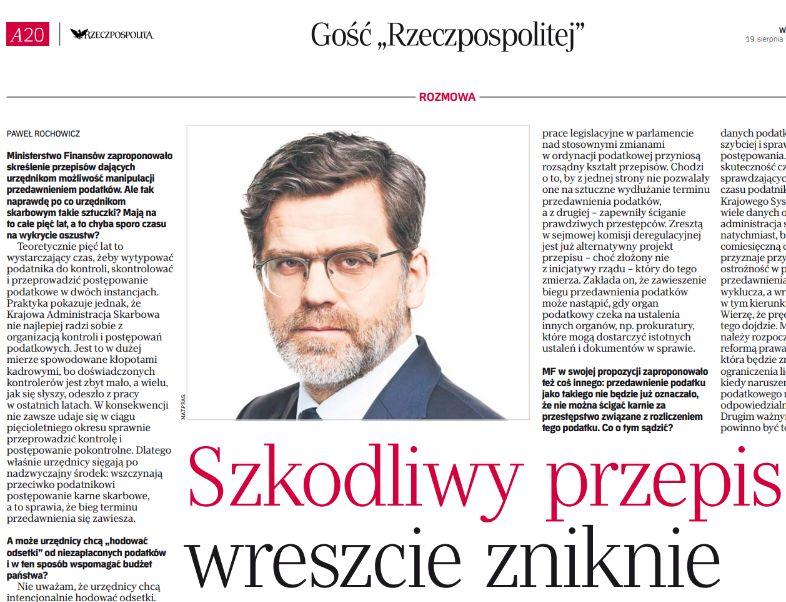
Harmful provision of tax regulations finally to be abolished – commentary by Andrzej Ladziński in Rzeczpospolita

What changes to the tax system are really needed? Andrzej Ladziński, managing partner at GWW and chairman of the National Chamber of Tax Advisers, comments in an interview with Rzeczpospolita on the Ministry of Finance’s proposals to remove the provision allowing tax authorities to initiate criminal tax proceedings for the purpose of suspending the limitation period.

‘The tax administration should not punish entrepreneurs for mistakes that it can easily identify itself in the new digital reality.’

Andrzej Ladziński also emphasises the need to shorten the limitation period for taxes and to reform criminal tax law so that the system does not punish errors that are easy to detect thanks to digitalisation.

The interview can be read on the newspaper’s website: https://lnkd.in/dHAEyW_n